
Ceramic Fiber Filter Products
Two Products, One Production Standard — Why That Matters to You
Both our standard ceramic fiber filter tubes and our catalytic DeNOx tubes are formed, fired, and inspected on the same dedicated production line in Jiangsu, China — the catalytic version simply adds catalyst coating and curing steps after the base tube is made. For you this means: identical dimensional standards (Φ60–Φ200 mm, up to 3,000 mm, ±2 mm OD / ±20 mm length tolerances), identical filtration performance at the base-tube level (1 μm precision, >99.9% dust removal), and one quality system (ISO 9001:2015) covering both. It also means switching between products, or running both in different lines of the same plant, involves no requalification of the base element — only the catalyst question needs to be settled.
Ceramic fiber filter is a porous filter which is made of refractory fiber and binder according to a certain scientific ratio. It integrates the functions of dedusting, desulfurization, denitrification, de-acid gas, de-dioxin and so on.
It runs continuously at up to 600℃ with a maximum service temperature of 1000℃, which greatly reduce many supporting equipment of desulfurization and denitrification system. And its service life is more than 5 years, backed by a 5-year written warranty.
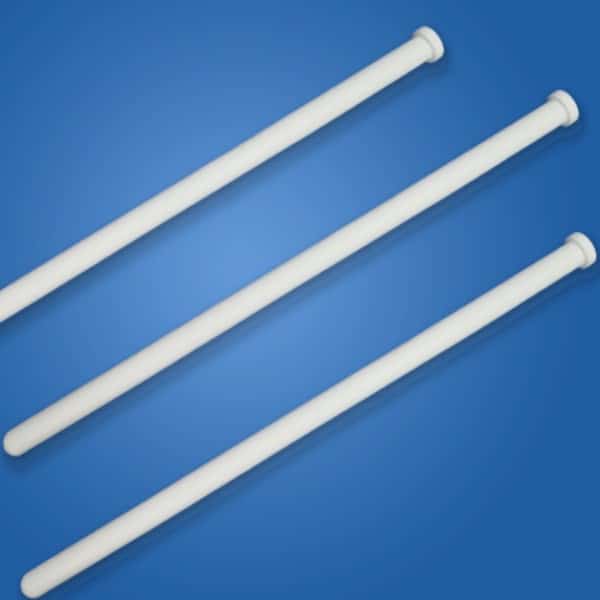
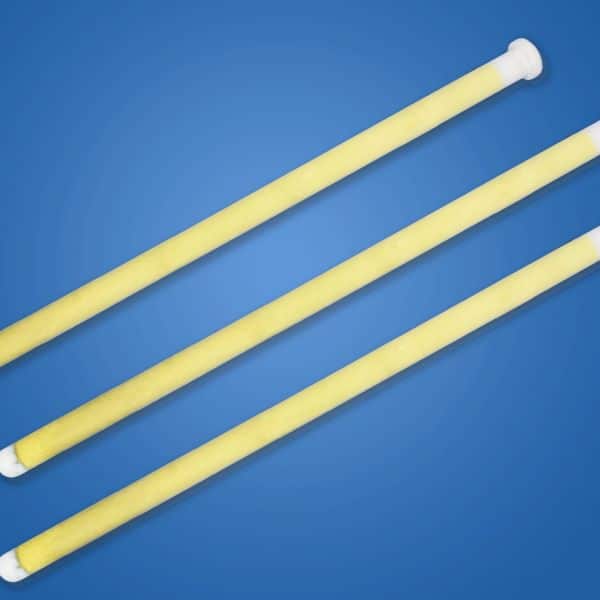
Product Comparison
Both product lines share the same high-temperature ceramic fiber (alumina and silica) base: continuous operation at up to 600°C with peaks to 1000°C, acid and alkali corrosion resistance, and a service life of more than 5 years, backed by a 5-year written warranty.
Both are supplied as rigid filter tubes — also known as hot gas filter candles or candle filter elements and cartridges — in outside diameters from Φ60 to Φ150 mm and lengths up to 3,000 mm.
| Feature | Non-catalyst Ceramic Fiber Filter | Catalytic Ceramic Fiber Filter |
|---|---|---|
| Primary function | High-temperature flue gas dedusting | Integrated dedusting + desulfurization + denitrification + de-acid gas + de-dioxin |
| Dust removal efficiency | > 99.9% | Integrated multi-function treatment |
| Residual dust after dedusting | < 5 mg/Nm³ | — |
| Desulfurization & denitrification | — | Up to 95% |
| NOx emission | — | < 50 mg/Nm³ |
| SO2 emission | — | < 30 mg/Nm³ |
| HCl removal | — | Up to 97% |
| Dioxin removal | — | Up to 97% |
| Typical applications | Thermal power plants, waste incinerators, cement kilns, metallurgy, brick plants, biomass boilers | Glass furnaces, steel furnaces, biomass boilers, thermal power plants, waste incinerators, coking plants, metallurgical smelting |
A Specialist, Not a Generalist
Guangzhou Anchor Technology has specialized in high-temperature ceramic filtration since 2019 — one product family, 40+ delivered projects in 7 countries. Production runs under an ISO 9001:2015 certified quality system, and CE documentation is available for European projects. When you inquire here, your technical questions are answered by engineers who work with these specifications daily, your custom dimensions are confirmed against drawings before production, and your quality claims trace back to batch lot records. There is no intermediary layer between your specification and the factory floor — which is exactly how industrial sourcing should work.
Before You Order: What We Need From You (and What You Get From Us)
A firm quotation from us requires five inputs: flue gas flow rate, operating and peak temperature, dust loading and chemistry, emission target, and destination port. In return you get: a product recommendation with honest suitability limits, dimensional confirmation or a custom design proposal, MOQ and lead time in writing, export packaging and documentation details, and — on request — samples before volume commitment. We do not quote systems we believe will underperform. If your conditions fall outside what ceramic filtration can reliably handle (HF above 5 ppm, phosphoric acid vapor, unmanaged condensation), we will say so in the first reply rather than in a warranty dispute two years later.
Frequently Asked Questions — Product Selection
How to Choose
Choose the non-catalyst ceramic fiber filter when your process needs high-temperature dedusting only — thermal power plants, cement kilns, waste incinerators, metallurgy, brick plants and biomass boilers.
Choose the catalytic ceramic fiber filter when you also need to remove SOx, NOx, HCl and dioxins in a single step — glass furnaces, steel furnaces, coking plants and metallurgical smelting.
Both lines share the same AW dimensional models (AW300 to AW3000-B). See the performance & test reports page for full dimensions and test data.
Not sure which fits your flue gas? Contact us with your gas parameters and we will recommend the right model and size.
Related guides: ceramic filter vs bag filter · ceramic candle filters
High Temperature Gas Filter Cartridges
Each ceramic fiber filter tube is, in effect, a high temperature gas filter cartridge: a self-supporting element that replaces the bag or pleated cartridge in a dust collector when the gas is too hot for textiles. High temp filters of this type handle dust-laden air and process gas at 600°C continuously, working as a high temperature dust filter and a high temperature air filter in one element, with dedusting efficiency above 99.9%. For hot gas filtration, ceramic filters of this candle design also remove the cooling stage that bag filters require, making high temperature gas filtration simpler and keeping the heat available for recovery. Even a high heat air filter duty on furnace exhaust air is covered by the same elements. In other words, a high temperature filter cartridge — or high temp cartridge filter — for gas cleaning is this rigid tube, not a pleated paper element.
Ceramic Candle Filters: The Product Family
A ceramic candle filter is a rigid, porous ceramic fiber tube — closed at one end, flanged at the other. It is the element inside every system we build, and it comes in the two grades shown above: the non-catalyst ceramic fiber filter (white tube) for high-temperature dedusting, and the catalytic ceramic fiber filter (yellow tube) with the catalyst integrated into the filter wall for combined dust, NOx and dioxin removal. Both run continuously at 600°C (1,000°C peak) with dedusting efficiency above 99.9% and residual dust below 5 mg/Nm³.
Pulse-Jet Cleaning
During filtration, dust builds a porous cake on the outer wall; that cake does much of the fine filtering. When the pressure drop reaches the set point, a short pulse of compressed air fires from the clean side and permeates outward through the wall, lifting the cake into the hopper. The element never leaves service for washing. For fine or sticky dust, a pre-coat of inert powder is applied before start-up — see the pre-coating guide.
Specifications
| Item | Value |
|---|---|
| Filter media | Refractory alumina-silicate ceramic fiber (Al₂O₃ 43–47%, SiO₂ 51–55%) |
| Fiber diameter | 3–5 μm |
| Outer diameter range | Φ60–Φ150 mm |
| Length | Up to 3,000 mm |
| Operating temperature | 600°C continuous, 1,000°C peak |
| Dedusting efficiency | >99.9%, residual dust <5 mg/Nm³ |
| Clean pressure drop | 300 Pa at 1 m/min face velocity (element); 900–1,500 Pa for a complete system |
| Design face velocity | 1.2–3.0 m³/min per m² of filter area |
| Cleaning | Pulse-jet back-blowing, in place |
| Typical service life | More than 5 years in typical duty |
Candle Filter vs Filter Bag
Fabric bags fail above roughly 260°C, so a baghouse on hot gas needs a cooling stage first — extra equipment, lost heat and a larger fan. Ceramic candle filters take the gas as it comes: no cooling stage, the heat stays available for recovery, and there is no fabric to burn, hydrolyze or blind at dew point. The full comparison is on our ceramic filter vs bag filter page, and replacing an existing baghouse is covered by the baghouse retrofit checklist.
Applications, Installation and Selection
Thermal power plants, waste-to-energy and biomass boilers, cement kilns, glass furnaces, metallurgical and brick plants — see the applications page. Ceramic elements are brittle compared with fabric bags, so installation accuracy decides service life; after installation a fluorescent powder leak test verifies every seal — procedure in the installation and leak detection guide. For sizing, start from the gas stream and follow the six steps in the element selection guide.
 English
  Deutsch
  简体中文
简体中文  한국어
한국어  日本語
日本語  Español
  Français
  Italiano
  Türkçe
  Tiếng Việt
  Português
  हिन्दी
  العربية
  Polski
  繁體中文
繁體中文