
Pre-coating filter tubes before a campaign is the cheapest insurance a plant will ever buy, and it is the step most often skipped. The reason it gets skipped is that nothing bad happens immediately: the vessel starts, the pressure looks normal, and the problem only surfaces months later as a differential pressure that will not come back down. By then the pores of the ceramic wall are already loaded with something that should never have touched them.
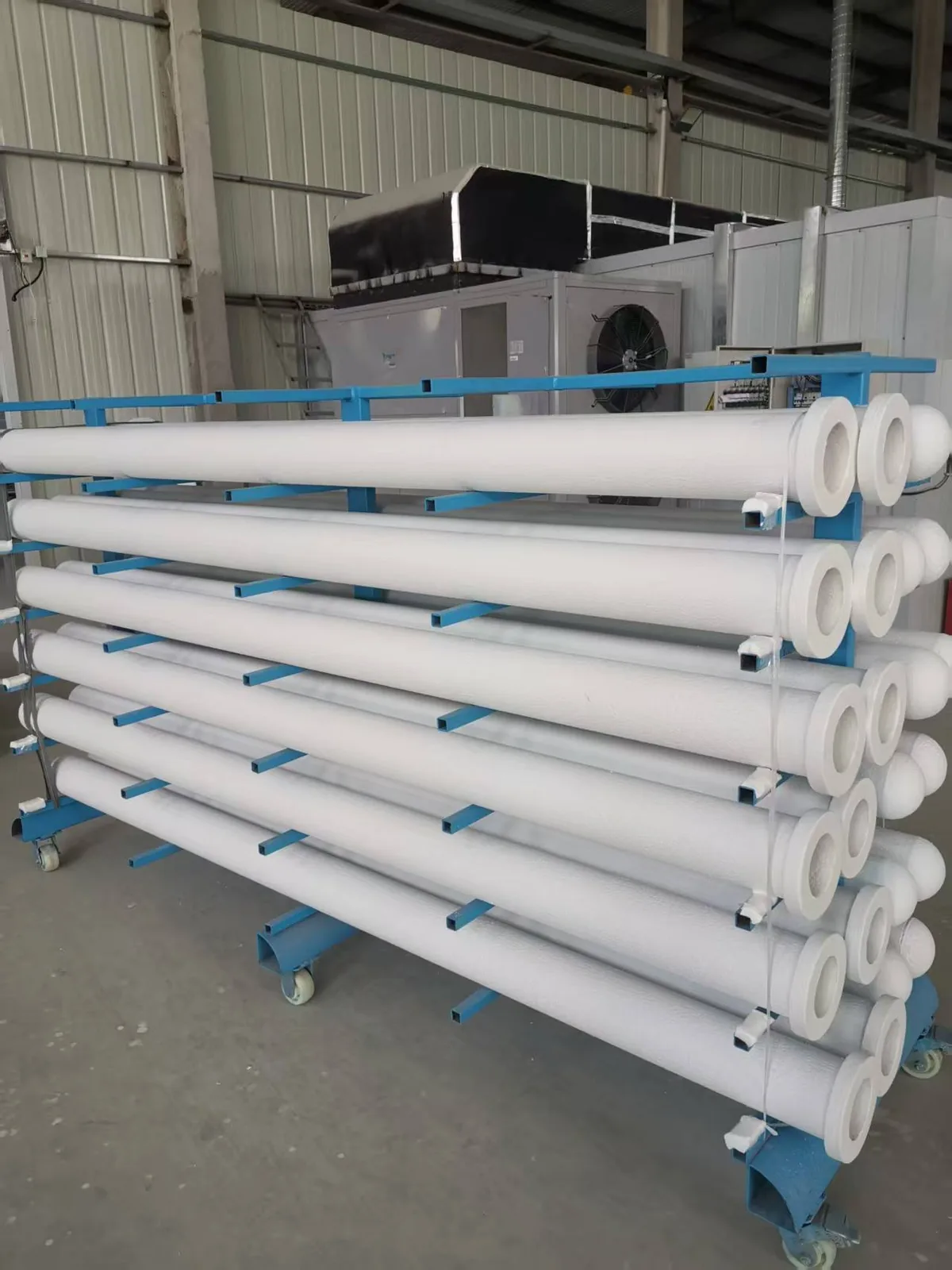
A rigid ceramic filter tube filters through a porous wall with more than 80% porosity. That open structure is what keeps the initial pressure drop down to 300 Pa at 1 m/min face velocity (clean), and it is also what makes the tube vulnerable during start-up. Sticky fly ash, tar and oil mist do not sit politely on the surface of a clean tube; they work into the pore mouths, and once they are there, no pulse of compressed air will shift them.
What pre-coating actually does
A pre-coat is a deliberately applied layer of dry, free-flowing powder laid down on the outside of the tube before the process gas arrives. It turns the tube surface into a sacrificial layer: the process dust lands on the pre-coat, the pre-coat is removed at cleaning, and the ceramic underneath never sees the sticky fraction at all. The filtration principle is unchanged — gas still passes through the wall and dust stays outside — but the material doing the first capture is now replaceable rather than structural.
There is a second benefit that operators notice immediately. A pre-coated tube reaches stable differential pressure faster. The first dust cake forms on a surface that already behaves like a dust cake, so the pressure trend settles into its operating band within hours rather than drifting for a day or two while the cake establishes itself unevenly.
In effect you are choosing what the tube will be protected by. Given the choice between a layer of lime powder you can replace at the next outage and a layer of tar that will require a chemical clean or a new tube, the decision writes itself.
When pre-coating is not optional
Some gas streams punish a bare tube from the first minute. The table below lists the situations where we treat pre-coating as a mandatory step rather than a recommendation.
| Situation | What happens without a pre-coat | Suggested pre-coat |
|---|---|---|
| Start-up and heat-up, any fuel | Condensate and sticky fines reach a cold, bare wall | Lime powder or limestone powder |
| Biomass boilers | Alkali-rich, sticky fly ash binds directly to the ceramic | Hydrated lime or limestone powder |
| RDF and refuse-derived fuel | Plastic-derived tars and oils condense in the pores | Lime powder, applied generously |
| Gas streams carrying tar or oil mist | Tar penetrates the pore structure and hardens | Lime powder, repeated after 24 hours |
| Restart after a long shutdown in a damp vessel | Residual moisture makes the first dust cake adhesive | Lime powder before re-start |
The common thread is stickiness. If the dust or vapour phase of your stream is tacky at the temperature of the tube wall — and during heat-up it always is, because the wall starts cold — then the tube needs protection before that stream arrives. Full application details by fuel type are on our applications page.
Choosing the pre-coat material
Lime powder and limestone powder are the default pre-coat materials, and for good reason: they are dry, cheap, alkaline, and available in the quantities a large vessel needs. Where the gas stream is acidic, the pre-coat does useful double duty, since the alkaline layer also starts neutralising acid components from the first minute of operation.
- Dry and free-flowing. Damp powder cakes instead of coating, and it brings its own moisture into a vessel that is trying to stay above dew point.
- Fine enough to form a continuous layer, coarse enough not to penetrate. The aim is a layer on the surface, not a partial blockage of the pores.
- Chemically compatible with the process. On an acidic stream, an alkaline powder helps. Where alkalinity is a problem downstream, use an inert mineral powder instead.
- Available in quantity. A large compartment needs hundreds of kilograms, dosed evenly over several hours.
Avoid using process fly ash as a pre-coat. It is free, which is why it is tempting, but fly ash from the stream you are trying to protect against is usually the sticky material itself, and recycling it onto a clean tube defeats the purpose.
How to pre-coat ceramic filter tubes, step by step
- Finish the mechanical work first. Complete installation and fluorescent powder leak detection before any powder goes in. A pre-coat on a leaking vessel hides the leak and wastes the dose.
- Bring the vessel above the acid dew point. Pre-coat onto a warm vessel. Powder laid onto a cold wall below dew point will pick up moisture and cake.
- Start the fan and set the filtration velocity to 2–5 cm/s. That is ≈1.2–3.0 m³/min per m² of filtration area — the same band the vessel will run in at duty.
- Feed lime powder or limestone powder upstream of the vessel. Inject into the duct or at the vessel inlet so the powder is fully dispersed in the gas before it reaches the tubes.
- Hold the dose until the differential pressure rises by a stable increment. Watch the trend rather than the clock; different vessels need different quantities to reach the same layer.
- Keep the pulse-jet cleaning system off, or on a very long interval. Cleaning during pre-coating strips the layer off the tube you have just coated.
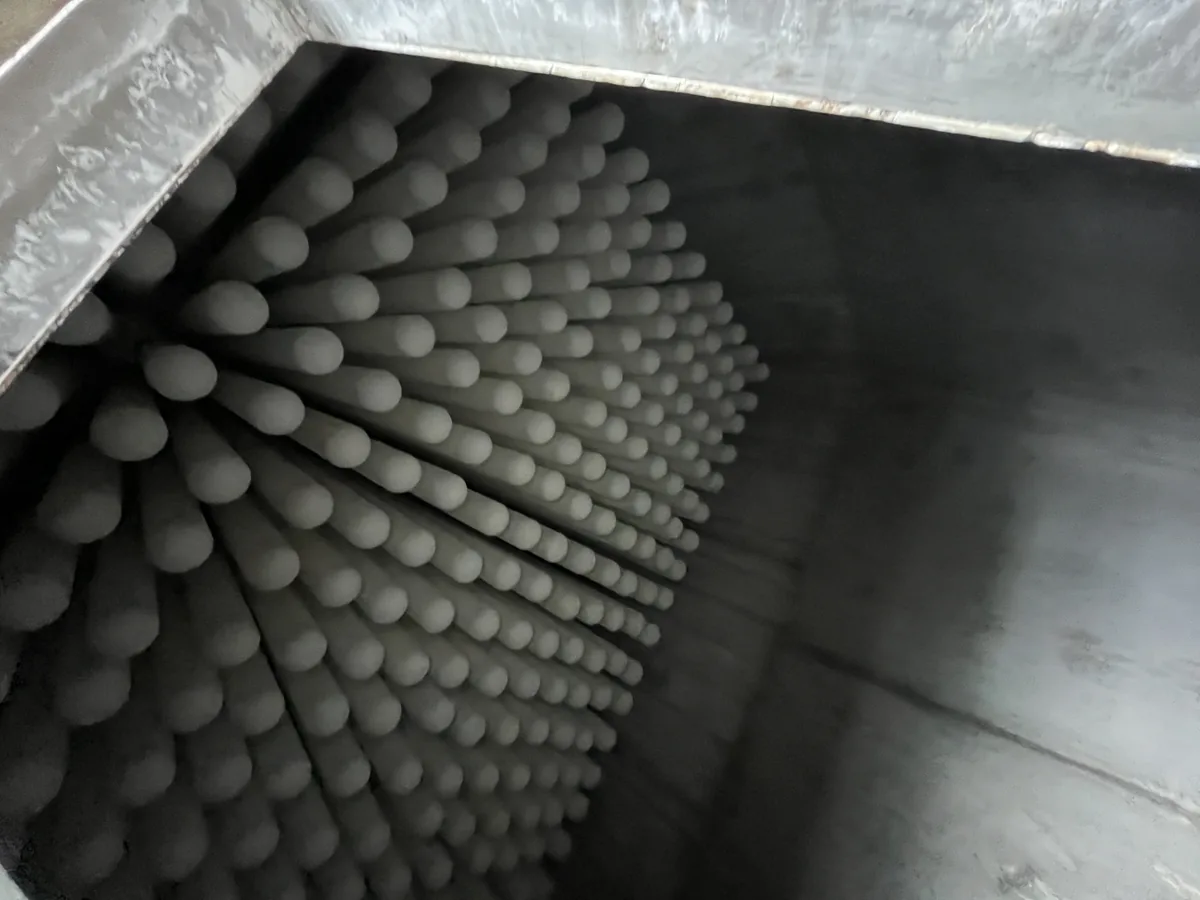
- Confirm the layer is even. Open an inspection port where possible and look at the tubes nearest the inlet as well as the ones furthest away.
- Once the differential pressure is stable, switch to normal duty. Bring the process stream in gradually and let the pre-coat hand over to the operating dust cake.
- Re-apply after any long shutdown. A pre-coat does not survive an outage in a damp vessel. Treat every restart as a fresh start-up.
Do not let the differential pressure run away during pre-coating. If it climbs faster than expected, stop dosing and check for moisture in the powder before you add more.
Holding the right face velocity
Filtration velocity decides whether the pre-coat lands evenly. At 2–5 cm/s the powder follows the gas to every part of every tube and builds a layer of consistent thickness. Push the velocity above that band and the powder concentrates where the gas velocity is highest, so the tubes nearest the inlet get a thick layer while the far end of the compartment stays nearly bare.
Too low is also a problem. Below the band, the gas does not carry the powder through the full length of the compartment, and the layer builds unevenly from the bottom up. The window that works for pre-coating is the same window that works for operation, which is convenient: 2–5 cm/s, or ≈1.2–3.0 m³/min per m² of filtration area.
Telling a good pre-coat from a bad one
Three failure signatures cover almost every case, and all three are readable from the pressure trend alone.
- Too thin. Differential pressure barely moves during dosing. The tube is unprotected and the first sticky dust will reach the ceramic. Continue dosing until the pressure rise is unmistakable.
- Too thick. The pressure climbs steeply from the very start and the vessel lands near the top of its operating band before process dust has even arrived. Reduce the dose rate and let cleaning remove part of the layer.
- Uneven. Pressure rises slowly and never stabilises. Check the injection point for poor dispersion and verify the filtration velocity is inside the 2–5 cm/s band.
For reference, a clean tube starts at 300 Pa at 1 m/min face velocity (clean), and system resistance in stable operation settles somewhere in the 900–1,500 Pa band. A pre-coat should move you part of the way from the first figure towards the second, not past it. Our published performance figures give the full picture for both catalytic and non-catalytic grades.
After the pre-coat: cleaning settings and handover to duty
Once normal duty begins, cleaning returns to its standard settings: 0.4–0.7 MPa, 0.1–0.15 s, triggered by differential pressure. Because the tube is rigid, the pulse releases the cake as a sheet without flexing the element, so there is no secondary dust and no pressure spike after each cycle. The pre-coat behaves exactly like an operating dust cake, and after the first few cleaning cycles it has effectively become one.
For the first campaign after a re-tube, set the cleaning trigger conservatively and let the cake run slightly thicker than you eventually will. A slightly thicker cake protects the tube, and you can tighten the setpoint once you have a week of pressure data to look at. The same approach applies to non-catalytic ceramic fibre filter tubes running sticky duty without a DeNOx requirement.
Frequently asked questions
How much pre-coat powder does a compartment need?
It depends on filtration area rather than on vessel volume, so work from the area: dose until the differential pressure shows a clear, stable rise, and record that quantity for the next start-up. On the first pre-coat, weigh the powder in and log the pressure curve so the second one is repeatable instead of guessed.
Can pre-coating replace proper start-up heating?
No, and this is a common misunderstanding. A pre-coat protects the tube from sticky dust; it does not protect the vessel from condensation. Bring the vessel above the acid dew point first, then pre-coat. Powder laid onto a cold, damp wall will cake, and caked powder is worse than no powder.
Should the pre-coat be applied with the cleaning system running?
No. Stop the pulse-jet system, or set it to a very long interval, until the layer is established. Cleaning during dosing removes the powder you have just applied and leaves the tube partly protected, which is the worst of the two outcomes because it looks like it worked.
How often should pre-coating be repeated?
At every cold start-up, and always after a shutdown long enough for the vessel to cool below dew point. On a plant that runs continuously, the operating dust cake effectively maintains itself and pre-coating is a start-up procedure rather than a routine one.
Does a pre-coat shorten filter life if it is left in place?
No. A lime or limestone pre-coat is chemically compatible with the ceramic and is removed by normal pulse-jet cleaning. What shortens life is the material the pre-coat is there to prevent: tar, oil mist and condensed acid working into the pore structure, which no cleaning cycle will remove.
Not sure whether your stream needs a pre-coat, or which powder suits it? Send us your fuel analysis, gas temperature profile and start-up sequence, and our engineers will specify the pre-coat material, dose rate and filtration velocity. Ask an engineer about pre-coating.
 English
  Deutsch
  简体中文
简体中文  한국어
한국어  日本語
日本語  Español
  Français
  Italiano
  Türkçe
  Tiếng Việt
  Português
  हिन्दी
  العربية
  Polski
  繁體中文
繁體中文