
Ceramic Fiber Filter Tube for High-Temperature Gas Dedusting
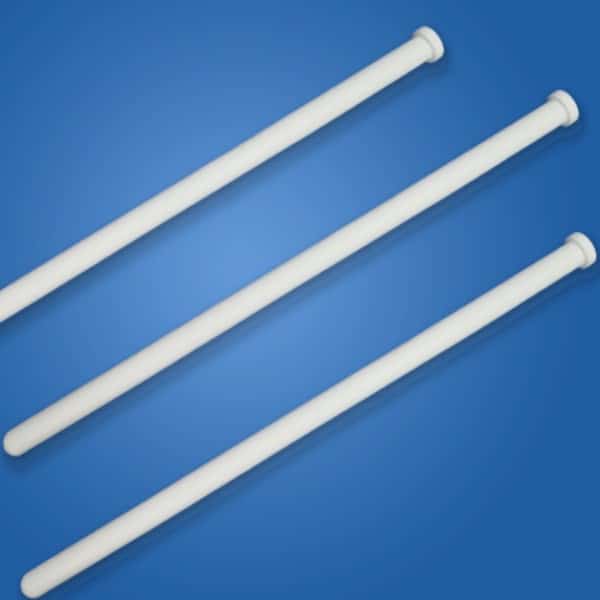
Product Description
This hot gas filter is a rigid, porous ceramic fiber filter tube for high-temperature dedusting, formed from refractory alumina-silicate fiber and binder. It is the non-catalytic grade — for combined dust, NOx and dioxin removal, see the catalytic ceramic fiber filter.
It runs continuously at up to 600℃ with a maximum service temperature of 1000℃, so that the dedusting system doesn’t need to cool down, and can recover the heat energy directly.
In dedusting, its use method and pulse backflush cleaning method are basically the same as that of the bag filter. But its service life exceeds 5 years, which is several times longer than that of the bag filter, and it can resist acid and alkali corrosion.
Product model and size specifications
| Model | Unit | AW300 | AW500 | AW1000-A | AW1000-B | AW1500-A | AW1500-B | AW2000 | AW1950 | AW2400 | AW3000-A | AW3000-B | |
| A | Length | mm | 300 | 500 | 1000 | 1000 | 1500 | 1500 | 2000 | 1950 | 2400 | 3000 | 3000 |
| B | Internal Diameter | mm | 110 | 40 | 40 | 110 | 40 | 110 | 120 | 120 | 80 | 120 | 110 |
| C | External Diameter | mm | 150 | 60 | 60 | 150 | 60 | 150 | 150 | 150 | 120 | 150 | 150 |
| D | Flange Diameter | mm | 190 | 80 | 80 | 195 | 80 | 195 | 195 | 200 | 160 | 195 | 195 |
| E | Flange Thickness | mm | 30 | 20 | 20 | 30 | 20 | 30 | 30 | 65 | 30 | 30 | 30 |
| F | Flange Shape | T | T | T | T | T | T | T | Y | T | T | T | |
| G | Surface Area | M² | 0.1 | 0.2 | 0.2 | 0.48 | 0.28 | 0.7 | 1 | 1 | 0.9 | 1.4 | 1.4 |
| H | Weight | kg | 1.3 | 0.4 | 0.65 | 3.2 | 0.9 | 4.5 | 5 | 5 | 5.5 | 7.5 | 8.5 |
Remark: It is normal for the actual size of the product to differ slightly from the above table.Please contact technical support for specific tolerance range. | |||||||||||||
Illustration: Below is Ceramic fiber filter’s dimension diagram :

Application:
Thermal power plants, waste incinerators, cement kilns, metallurgical industries, brick plants, biomass boilers and other dust generated scenes
For simultaneous SOx, NOx and dioxin removal, see our catalytic ceramic fiber filter. Contact us for a quotation.
Work efficiency:
Dust residual after dedusting<5mg/Nm3
Dedusting efficiency>99.9%
Remark: The removal rate of the pollutants in the flue gas depends on the performance of the additives, as well as the design, construction, and the operation level of the equipment.
Key Specifications
| Parameter | Value | ||
|---|---|---|---|
| Filtration accuracy | ≥ 1 μm (dust larger than 1 micron) | Max long-term operating temperature | 600 °C continuous / 1000 °C max (dedusting mode) |
| Filter resistance (room temperature) | 300 Pa (1 m/min, clean) | Whole dedusting system resistance | 900–1,500 Pa |
| Filtration (face) velocity | 2 – 5 cm/s | Backflush pressure | 0.4 – 0.7 MPa |
| Backflush duration / trigger | ≈ 0.15 s, pressure-difference triggered | Dedusting efficiency | >99.9% |
| Dust residual emission | < 5 mg/Nm3 | Service life | More than 5 years (5-year written warranty) |
| Operating mode | Pulse-jet cleaning, similar to baghouse layout | Physical strength | Maintains high strength at room and high temperature without keel reinforcement |
Source: Anchor Technology laboratory & field data. For project-specific selection consult our engineering team.
Manufacturing Quality Control & Material Traceability
Every production batch at Anchor Technology starts with high-purity alumina-silicate fiber (Al₂O₃ 43–47%, SiO₂ 51–55%) sourced from certified Chinese suppliers. Our automated fiber spinning line controls fiber diameter to 3–5 μm with <5% standard deviation — this uniformity is critical for achieving consistent 1 μm filtration precision. After forming and sintering at 1,250°C, each tube undergoes visual inspection, dimensional verification, and mechanical strength testing (minimum 4 MPa tensile strength, minimum 500 N radial crush resistance).
For export orders, we provide a Certificate of Analysis (COA) with each shipment documenting fiber chemical composition, dimensional measurements, porosity (>80%), and filtration efficiency results from batch sampling tests. Production runs under an ISO 9001:2015 certified quality system, and third-party inspection (SGS, BV, TÜV) before shipment is welcome.
Chemical Compatibility
| Medium | Compatibility | Notes |
|---|---|---|
| Common acid gases (SOx, HCL, H2S) | Resistant | Standard operating envelope |
| Alkali dusts | Resistant | With standard binder |
| HF (hydrofluoric acid) | Limited | Requires alkali-resistant coating agent |
| H3PO4 (phosphoric acid) | Limited | Requires special agent |
| Na2O / K2O | Limited | No alkali agent added |
| Direct flame contact | Yes | Non-combustible ceramic fiber |
Field-Proven Performance in High-Temperature Dust Removal
Anchor Technology has supplied non-catalytic ceramic fiber filter tubes to 40 industrial dust collection systems since 2019, including cement kiln preheater exhausts, municipal waste incinerators and biomass power plants. In a typical cement plant retrofit we completed in 2019 (2,500 t/d clinker line, Shandong Province), our 120 ceramic tubes replaced failing glass fiber bags and maintained <3 mg/Nm³ particulate emissions for over 4 years without replacement, despite 850°C continuous operation and frequent thermal cycling from 400°C to 850°C during kiln start-ups.
Unlike fabric filter media that rely on a sticky dust cake for filtration, our rigid ceramic fiber structure provides both surface and in-depth filtration from the first minute of operation — there’s no “break-in” period. The pulse-jet cleaning cycle (typically 0.4–0.7 MPa compressed air at differential-pressure-triggered cleaning cycles) releases the dust cake cleanly because the smooth ceramic surface doesn’t trap fine particles in the fiber interstices the way woven fabrics do. This is why our customers report stable 900–1,500 Pa system pressure drop over years of operation, versus fabric bags that gradually climb to 3,000+ Pa as particles embed in the weave.
Why Source from Anchor Technology
Anchor Technology is a specialist supplier of high-temperature ceramic filtration — not a general trading house. The elements are produced on dedicated ceramic fiber lines in Jiangsu, China, and we verify every batch against specification before it ships: fiber composition, dimensions, porosity and strength. That means controlled quality, custom dimensions and chemical treatments matched to your process, and engineering support from people who work with these specifications every day. Our customers include cement groups like CNBM and Conch, waste-to-energy operators like Everbright International, and industrial boiler manufacturers across Southeast Asia and Europe.
We stock standard sizes (Φ120×1000, Φ120×2000, Φ150×2000) for immediate shipment and can deliver custom specifications in 45–60 days. For technical questions or to request a sample, contact our engineering team directly at [email protected] or WhatsApp +86 137 0305 0828. We respond to all inquiries within 24 hours on business days.
Frequently Asked Questions About Non-Catalytic Ceramic Fiber Filter Tubes
Technical Datasheet (PDF)
Download the complete technical datasheet for engineering selection: dimensional drawings, pressure-drop curves, model-to-cloth-area mapping, mechanical-load curves and chemical compatibility reference.
Request the PDF datasheet We will reply within 1 business day with the PDF and a sizing recommendation.
Common questions answered in our technical FAQ and working principle pages.
Related guides: installation and fluorescent leak detection · pre-coating guide · ceramic candle filter page
 English
  Deutsch
  简体中文
简体中文  한국어
한국어  日本語
日本語  Español
  Français
  Italiano
  Türkçe
  Tiếng Việt
  Português
  हिन्दी
  العربية
  Polski
  繁體中文
繁體中文