
Most ammonium bisulfate SCR problems reported in low-temperature DeNOx systems are not catalyst failures at all — they are operating-window failures. Ammonium bisulfate (NH₄HSO₄, usually abbreviated ABS) forms whenever SO₃, unreacted ammonia and water vapour coexist below roughly 300 °C, and it condenses as a sticky gel that blocks pores and covers active sites. Because catalytic ceramic filters deliberately run in the 170–300 °C band, they sit right inside the temperature range where this salt can appear. The good news is that ABS formation is predictable and largely reversible if you control three variables and schedule one maintenance procedure. This article explains how to do that, and how ABS differs from the deactivation mechanisms that are permanent.
How Ammonium Bisulfate Forms
The reaction needs three ingredients and a temperature ceiling. Sulphur trioxide comes from oxidation of SO₂ across the catalyst itself or in the gas phase; ammonia comes from ammonia slip — the fraction of injected NH₃ that leaves the reactor without having reduced a NO molecule; water is always present in combustion flue gas. Below approximately 300 °C the three combine into ammonium bisulfate, a gel-like particulate that is solid enough to deposit and viscous enough to hold dust.
Two aspects of that description matter operationally. First, temperature is a threshold, not a gradient: above the dew point of ABS the salt does not condense and the problem simply does not exist, which is why conventional high-temperature SCR at 300–400 °C rarely sees it. Second, ammonia is the ingredient you control directly. If slip were zero, SO₃ alone could not make ABS. That is why ammonia dosing discipline is the single most effective lever an operator has.
Why ABS Is Damaging Inside a Catalytic Filter
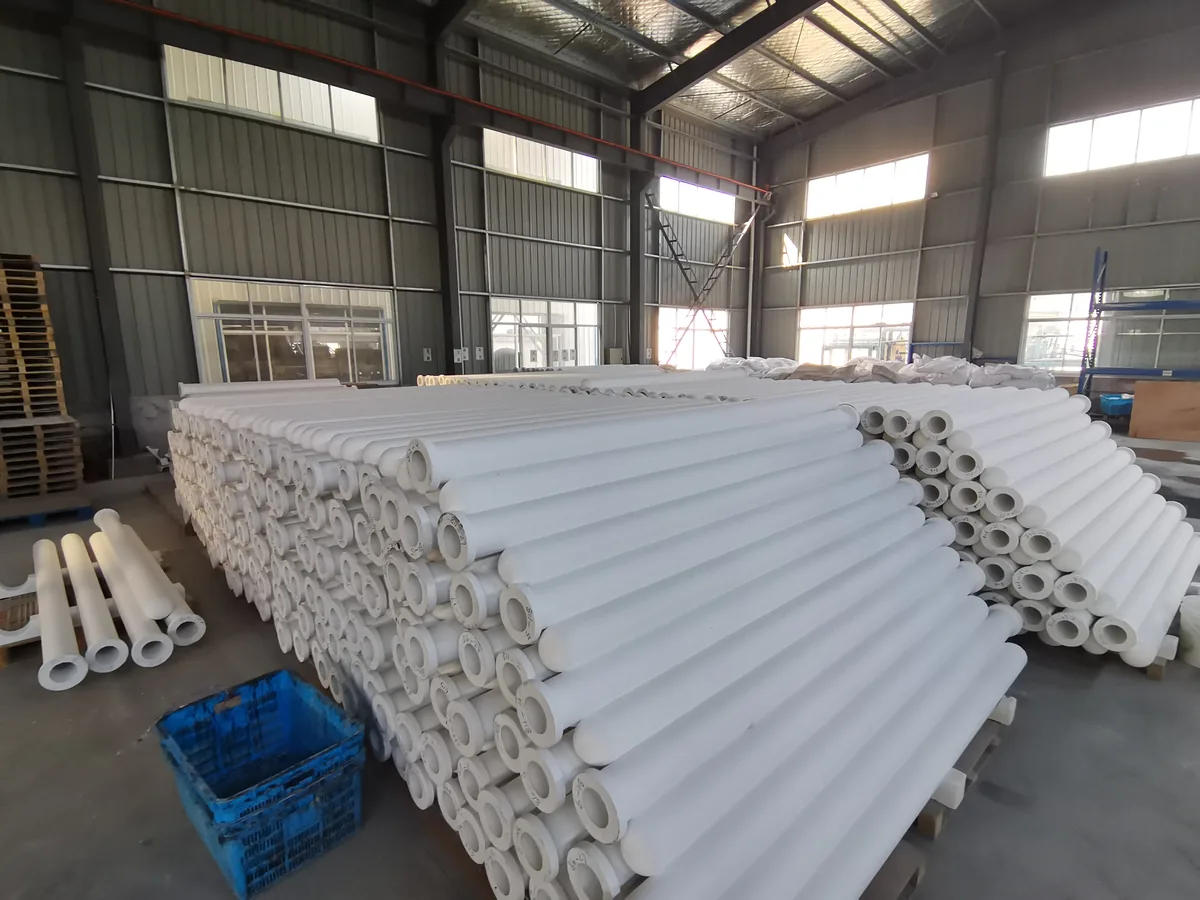
In a catalytic ceramic filter the consequences are more immediate than in a honeycomb reactor, because the same element is doing filtration and catalysis at once — particulate capture stays >99.9% while NOx is reduced in the same wall. The standard element is φ150 × φ110 × 3,000 mm with a 20 mm wall, tolerance OD ±2 mm / length ±20 mm and >80%, run at a filtration velocity of 2–5 cm/s (≈1.2–3.0 m³/min per m²) and cleaned at 0.4–0.7 MPa for 0.1–0.15 s on a differential-pressure trigger. Deposited ABS narrows those pores, so an element that started at 300 Pa at 1 m/min face velocity (clean) climbs toward the top of its 900–1,500 Pa operating band and triggers more frequent pulse cleaning. At the same time the gel coats active sites, so DeNOx efficiency falls even though the catalyst chemistry is untouched — which is why operators often see rising differential pressure and falling NOx removal appearing together.
The dust cake makes it worse. A sticky filter surface holds ash that a clean surface would release, so the cake thickens, cleaning energy rises and the cycle accelerates. Left long enough, ABS mixed with fly ash can harden into a crust that pulse-jet cleaning cannot remove at all. Recognising the pattern early — rising pressure drop at constant gas flow, rising ammonia consumption for the same NOx outlet, and a temperature history with extended time below 270 °C — is what keeps this a maintenance task instead of a catalyst replacement.
Control 1: Limit the SO₂-to-SO₃ Conversion
Every molecule of SO₃ in the vessel is a potential molecule of ABS, and the catalyst itself is the main place SO₃ is made. Vanadium-based formulations are effective DeNOx catalysts but they also oxidise SO₂, and that conversion rate rises with temperature and with vanadium content. The standard mitigation is formulation: adding tungsten trioxide (WO₃) to the catalyst suppresses SO₂ oxidation while maintaining DeNOx activity, and it also improves thermal stability of the active phase.
From the operator’s side the equivalent measure is to keep SO₂ entering the vessel as low as practical. Keeping inlet SO₂ below 50 mg/m³ (S.T.P., dry) is not only the boundary for good dioxin destruction in a selective catalytic oxidation system, where removal reaches up to 99.5% (TEQ) — it also shrinks the SO₃ inventory available for ABS formation. Dry alkaline powder injection ahead of the vessel does both jobs at once, and the spent sorbent leaves with the dust cake. Catalyst formulation and loading options are described on our catalytic ceramic fiber filter page.
Control 2: Hold the Ammonia-to-NOx Molar Ratio at 0.9–1.1
The ammonia-to-NOx molar ratio (often written NSR) is the ratio at which you dose, and 0.9–1.1 is the band that keeps DeNOx high while keeping slip low. Below 0.9 you leave NOx on the table; above 1.1 the surplus ammonia has nothing to react with and becomes slip, which is precisely the feedstock for ABS at low temperature. Because the catalytic filter operates at 170–300 °C with an optimum at 220–260 °C, there is less margin here than in a hot SCR: the same slip rate that is harmless at 350 °C will condense at 230 °C.
Practical measures that hold the ratio steady:
- Size the ammonia injection grid for good distribution, and verify it with a traverse at commissioning rather than trusting the design.
- Use feedback from the outlet NOx analyser rather than fixed feed-forward dosing, so load swings do not produce ammonia spikes.
- Trend ammonia consumption against NOx removed. A rising ratio at constant outlet NOx is the earliest reliable warning of both slip and ABS onset.
- Check injection grid nozzles for blockage during every outage; a partially blocked grid produces local over-dosing even when the total flow is correct.
Control 3: Avoid Sustained Low-Temperature Operation
Temperature is the third lever, and it interacts with the other two. At 200 °C the DeNOx efficiency is around 90%; at 280 °C it reaches 98%. Operating at the bottom of the window is not forbidden, but it costs you efficiency and it puts the vessel deeper into the ABS region, so sustained running at 170–200 °C should be a deliberate decision with a plan attached, not a default that emerged from a boiler operating at part load.
Where low-temperature operation is unavoidable — frequent start-ups, seasonal part load, a waste heat boiler that over-cools — the compensating measures are a lower ammonia ratio, more aggressive sorbent injection, and a shorter interval between thermal regeneration cycles. Start-ups deserve particular attention: the vessel is cold, the catalyst is not yet at its active temperature, and dosing ammonia into a cold reactor is the fastest way to load it with ABS before the gas has even reached the DeNOx window.
Thermal Regeneration: Raise the Vessel Above 350 °C for 12 Hours
ABS decomposes when heated above its formation temperature, so deposits already formed can be driven off thermally. The established procedure is to raise the filter housing temperature above 350 °C and hold it there for at least 12 hours. That is long enough for the salt to decompose through the full wall thickness and for the released SO₃ and ammonia to be swept out with the gas, not just for the surface layer to dry out.
Schedule the thermal soak on a fixed calendar rather than waiting for pressure drop to force it. A practical starting point is one soak per quarter for plants that spend significant time below 250 °C, and one per year for plants that sit comfortably in the 220–260 °C optimum. Stop ammonia injection during the soak and confirm that the temperature is measured at the housing, not only at the inlet duct.
The element tolerates this without difficulty: it is rated for 1100 °C continuous service and 1300 °C for no more than 30 minutes, so a 350 °C soak is well within the mechanical and thermal envelope. Regeneration is not a cure for every problem, though — it removes ABS, it does not restore sites poisoned by alkali metals or heavy metals.
Deactivation Mechanisms That Are Not Reversible
ABS gets most of the attention because it is dramatic and recoverable, but permanent deactivation is what actually sets element life. The mechanisms below are chemical, and none of them can be reversed by heating.
| Mechanism | Source | Effect | Reversible? |
|---|---|---|---|
| Ammonium bisulfate | SO₃ + excess NH₃ + H₂O below ~300 °C | Pore blocking, active-site coverage, rising dP | Yes — heat above 350 °C for 12 h |
| Alkali metals (Na, K) | Biomass ash, glass furnace dust, alkali-rich sorbent | Neutralises acid active sites, permanent activity loss | No |
| Heavy metals (Pb, Zn) | Secondary raw materials, certain waste streams | Site blocking, reduced pore accessibility | No |
| Dust cake hardening | Ca(OH)₂ moisture above 0.8% or gas humidity above 20%, with 12 continuous hours below 270 °C | Cemented cake that pulse cleaning cannot release | Partially, by mechanical cleaning |
| Fluoride and phosphorus | HF above 5 ppm, phosphoric acid mist | Attacks the ceramic substrate and active phase | No |
The dust cake hardening case deserves a note, because it is often mistaken for ABS. It involves hydrated lime sorbent that is too wet, or a gas stream with too much moisture, held below 270 °C for long enough that the cake sets. The symptoms look similar — differential pressure climbs and cleaning stops working — but the remedy is sorbent and moisture control plus mechanical intervention, not a thermal soak. Operating data and diagnostic limits are maintained on our QA page.
Chemical Boundaries to Screen Before You Specify
Catalytic ceramic filter elements tolerate a very wide range of industrial flue gases, but four conditions need to be screened at the enquiry stage rather than discovered in operation: hydrogen fluoride above 5 ppm, phosphoric acid mist, alkali oxides (Na₂O, K₂O) where no alkaline absorbent is used, and sustained operation below the catalytic window of 170–300 °C. Where one of these is present, the usual mitigation is upstream dry sorbent injection and, for fluoride and phosphorus, a dedicated guard bed or a change of sorbent.
Operating Checklist
- Log housing temperature continuously and alarm on time spent below 250 °C, not just on instantaneous low temperature.
- Trend ammonia consumption divided by NOx removed; investigate any sustained drift upward.
- Keep inlet SO₂ below 50 mg/m³ (S.T.P., dry) using dry alkaline powder injection ahead of the vessel.
- Record differential pressure at constant gas flow; compare against the 300 Pa clean baseline and the 900–1,500 Pa operating band.
- Check sorbent moisture at delivery — Ca(OH)₂ above 0.8% moisture is a hardening risk when combined with low temperature.
- Schedule the 350 °C / 12-hour soak on the calendar and stop ammonia dosing during it.
Handled this way, ammonium bisulfate becomes a managed maintenance item rather than a cause of early catalyst replacement. Element service life is more than 5 years with a 5-year written warranty, and the operating envelope for the reaction is documented further under principle and performance. Anchor has been building these systems since 2019 and has delivered more than 40 projects, including a 750 t/d waste incineration line in Nansha, Guangzhou and a 2,500 t/d cement clinker line in Shandong commissioned in 2019.
Frequently Asked Questions
At what temperature does ammonium bisulfate form?
Below roughly 300 °C, when SO₃, excess ammonia and water vapour are all present. Above that temperature the salt does not condense, which is why conventional high-temperature SCR in the 300–400 °C band rarely encounters it. Catalytic ceramic filters operate at 170–300 °C with an optimum at 220–260 °C, so ABS control has to be designed in rather than assumed away.
How do you remove ABS that has already formed?
Raise the filter housing temperature above 350 °C and hold it for at least 12 hours, with ammonia injection stopped. The salt decomposes and the released components leave with the gas. The element is unaffected by the treatment — it is rated for 1100 °C continuous operation and 1300 °C short-term excursions of up to 30 minutes.
What ammonia-to-NOx ratio should I run?
Hold the molar ratio between 0.9 and 1.1. Below 0.9 you lose DeNOx performance; above 1.1 the surplus ammonia becomes slip and feeds ABS formation. Ratio control matters more at low temperature than in a hot reactor, so pair it with a well-distributed injection grid and outlet NOx feedback rather than fixed feed-forward dosing.
Does WO₃ really reduce SO₃ formation?
Yes. Adding tungsten trioxide to the catalyst formulation suppresses the oxidation of SO₂ to SO₃ while maintaining DeNOx activity, which directly reduces the raw material available for ABS. It is a catalyst selection decision, so it needs to be raised at specification time along with your sulphur content and temperature profile.
How can I tell ABS apart from alkali poisoning?
ABS develops quickly, correlates with low-temperature operating periods and responds to a thermal soak — differential pressure recovers and DeNOx returns. Alkali and heavy metal poisoning develop slowly over months, correlate with fuel or raw material changes, and do not respond to heating. If a 350 °C soak produces no recovery, suspect chemistry rather than condensation.
Does ABS shorten the 5-year element life?
Not if it is managed. ABS is reversible, and a vessel operated inside the 170–300 °C window with the ratio controlled at 0.9–1.1, inlet SO₂ below 50 mg/m³ (S.T.P., dry) and periodic regeneration should still reach more than 5 years of service under the 5-year written warranty. Extended unmanaged exposure, especially when it leads to a hardened dust cake, is what turns a reversible problem into a replacement.
Share your flue gas analysis, temperature profile and ammonia dosing practice and we will assess your ABS risk, recommend a regeneration interval and confirm whether a catalytic filter is the right fit for your duty. Talk to an engineer.
 English
  Deutsch
  简体中文
简体中文  한국어
한국어  日本語
日本語  Español
  Français
  Italiano
  Türkçe
  Tiếng Việt
  Português
  हिन्दी
  العربية
  Polski
  繁體中文
繁體中文