
The catalytic ceramic filter vs SCR debate is usually framed as a technology contest, but on a real project it is almost always an equipment-count question. Both routes can deliver the same NOx figure at the stack; what differs is how much hardware, how much plot area and how much operating attention it takes to get there. A conventional train puts a baghouse or electrostatic precipitator, a wet or semi-dry scrubber and an SCR reactor in series, each with its own vessel, ductwork, fan duty and control philosophy. A catalytic ceramic filter collapses particulate removal, desulphurisation, DeNOx and dioxin destruction into one housing. This article compares the two on capex, opex, footprint and risk, including the cases where SCR remains the better engineering answer.
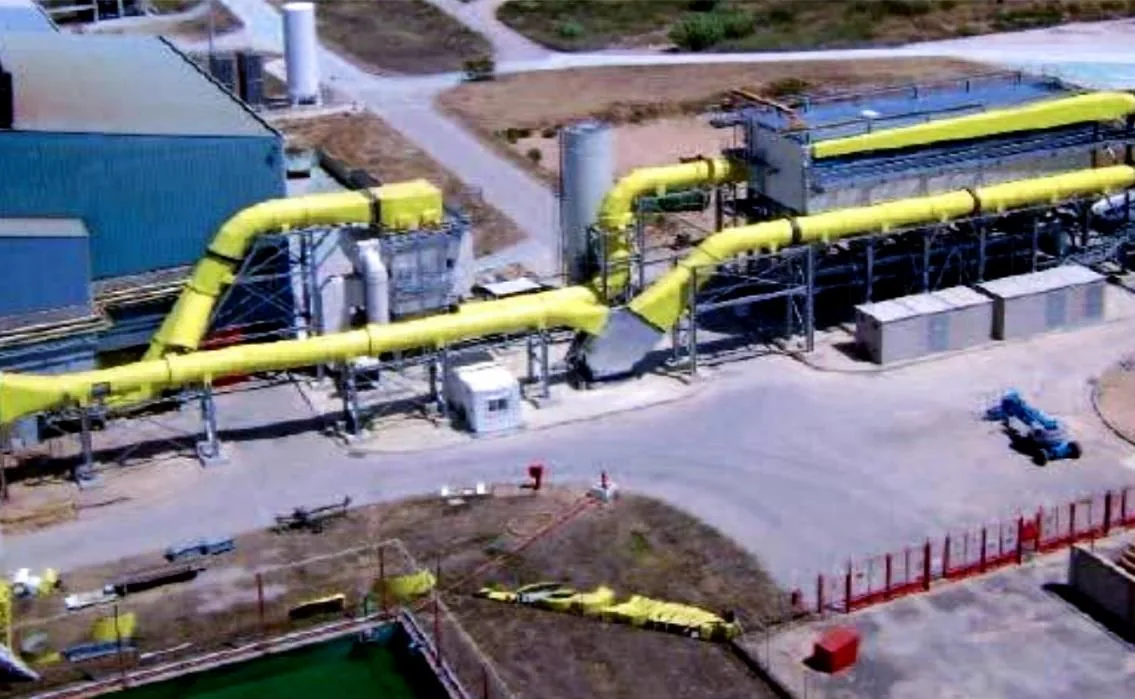
The Conventional Train: Three Systems in Series
The standard arrangement for a waste incinerator, cement kiln or biomass boiler has not changed much in twenty years. Particulate is removed first, in a baghouse or an electrostatic precipitator, because everything downstream works better on clean gas. Acid gases are then handled in a wet scrubber or a semi-dry spray absorber, which is where most of the water consumption and the wastewater stream originate. Finally the gas is reheated and passed through an SCR reactor for NOx reduction, because the catalyst needs a temperature window that the scrubber outlet cannot deliver on its own.
Each step is individually well understood and individually optimised, which is exactly why the arrangement persists. The weakness is accumulated: three pressure-drop contributors in series, three control systems, three sets of spare parts, three vendor scopes and a reheat duty inserted between steps two and three purely to satisfy the catalyst. When you add up the ducts, the expansion joints and the access platforms, the physical length of the train often exceeds the available space on a retrofit site long before the process design is finished.
The Integrated Alternative: One Vessel, Four Functions
A catalytic ceramic filter element is a rigid candle with catalyst distributed through the wall rather than coated on the outside. Gas flows from the dirty side inward, particulate is captured on the outer surface at better than 99.9% efficiency, and the gas then travels through a catalytically active depth of 20 mm before it reaches the clean plenum. If ammonia is injected upstream, DeNOx happens in the same wall; if the temperature is in the 170–300 °C band with an optimum at 220–260 °C, dioxins are simultaneously oxidised to CO₂, H₂O and HCl.
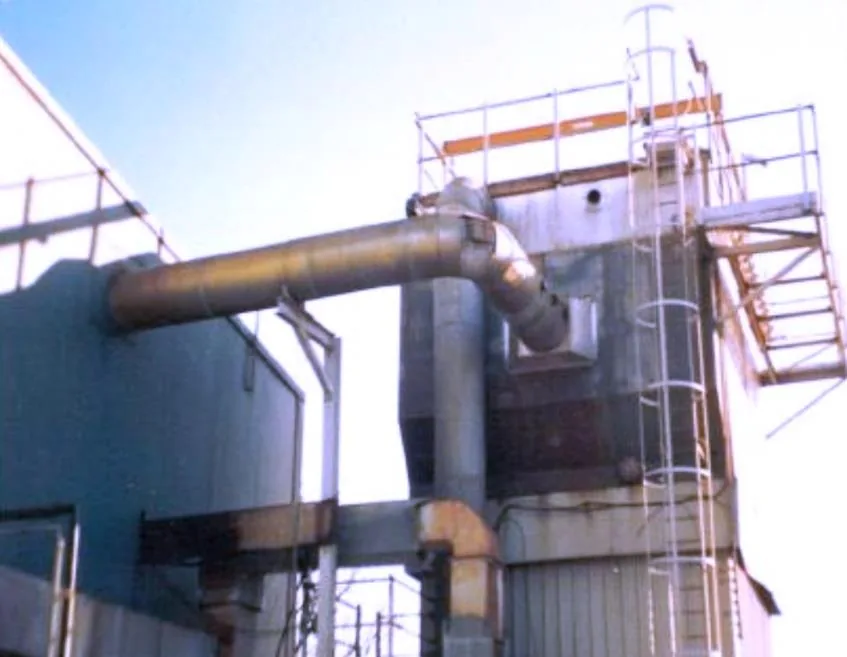
DeNOx performance follows the same curve as any low-temperature catalyst: roughly 90% at 200 °C rising to 98% at 280 °C, with dioxin destruction reaching up to 99.5% (TEQ) across the optimum band. Desulphurisation is handled by injecting dry alkaline powder into the duct ahead of the vessel; the reaction product joins the dust cake and is removed by the same pulse-jet system. No scrubber tower, no recirculation pumps, no wastewater treatment. The full construction and catalyst loading options are described on our catalytic ceramic fiber filter page, and the operating principle is explained step by step under principle.
Capital Cost: Where the Money Actually Goes
There is no honest way to quote a universal capex ratio, because it depends on gas volume, sulphur content, permit limits and how much civil work the site needs. What can be compared is the number of cost centres. The conventional train carries a precipitator or baghouse, a scrubber with its recirculation and effluent system, a reheat stage, an SCR reactor with its ammonia injection grid and its own steel structure, plus the interconnecting ductwork between all of them. The integrated route carries one vessel, one dust removal system, one sorbent injection skid and one ammonia skid.
The element itself is more expensive per unit of filter area than a filter bag, which surprises buyers who compare only media prices. That comparison is misleading: the catalytic element is replacing filter media, SCR catalyst and part of the scrubber in one purchase. Where the economics usually turn decisively is the balance-of-plant — civil foundations, structural steel, ductwork, insulation, cabling and instrumentation — which for a three-vessel train can equal or exceed the cost of the process equipment itself.
Operating Cost: Energy, Water and Ammonia
| Cost driver | Conventional train (ESP/baghouse + scrubber + SCR) | Integrated catalytic ceramic filter |
|---|---|---|
| Reheat duty | Gas must be reheated after wet or semi-dry scrubbing to reach the SCR window, typically with gas, steam or a gas-gas heater | None; the catalytic window of 170–300 °C is reached without reheating |
| Water and effluent | Scrubber make-up water plus a wastewater treatment obligation | Dry sorbent only; no liquid effluent |
| Pressure drop | Three resistances in series plus the reheat exchanger | Clean element 300 Pa at 1 m/min face velocity; system resistance 900–1,500 Pa |
| Ammonia consumption | Stoichiometric at 300–400 °C with good mixing | Similar stoichiometry; slip must be managed more carefully at low temperature |
| Consumables | Bags or electrodes, scrubber reagent, SCR catalyst replacement | Elements on a multi-year cycle, dry sorbent |
The single largest opex item that disappears in the integrated route is reheating. Raising several hundred thousand cubic metres per hour of scrubbed gas by 60–100 K is a permanent fuel or steam bill that never appears in the scrubber line item, which is why it is so often underestimated in comparisons. Water is the second, and it comes with a permitting and treatment burden rather than just a utility cost.
Footprint and Retrofit Adaptability
Footprint is where the two routes differ most visibly. A three-vessel train needs linear length: gas enters at one end and progresses through stages, and each transition requires ductwork with its own support steel and access. An integrated vessel is a single shell that can often be placed on the footprint of an existing baghouse, which is why conversions are frequently feasible on sites where adding an SCR reactor is not.
Elements are φ150 × φ110 × 3,000 mm with a wall thickness of 20 mm, tolerance OD ±2 mm / length ±20 mm and >80%, and they hang from a conventional tubesheet. Design filtration velocity is 2–5 cm/s (≈1.2–3.0 m³/min per m²). Existing pulse-jet headers can usually be reused with a change of nozzle, cleaning at 0.4–0.7 MPa for 0.1–0.15 s on a differential-pressure trigger, and particulate removal stays >99.9% across that range. The two checks that decide whether a conversion is straightforward are fan margin against 900–1,500 Pa of system resistance, and whether the gas temperature profile puts the vessel inside the catalytic band for the majority of operating hours.
Catalyst Poisoning, Plugging and Ammonium Bisulfate
Every catalyst degrades; the question is how quickly and how reversibly. Both routes are vulnerable to alkali metals (sodium and potassium), heavy metals such as lead and zinc, and to the chemical boundaries that apply to ceramic systems generally — hydrogen fluoride above 5 ppm, phosphoric acid mist, and alkali oxides where no alkaline absorbent is used. The difference is in exposure. In a conventional train the SCR catalyst sits downstream of a scrubber and a particulate control device, so it sees relatively clean, desulphurised gas. In an integrated vessel the catalyst sees the raw dust load, which is why filtration efficiency above 99.9% and a stable dust cake matter so much to catalyst life.
The other shared risk is ammonium bisulfate. Below roughly 300 °C, SO₃, excess ammonia and water combine into a sticky gel that condenses in pores and on active sites, raising differential pressure and cutting DeNOx efficiency. Low-temperature operation is what creates the risk, so an integrated vessel running at 220–260 °C needs disciplined ammonia control — an ammonia-to-NOx molar ratio of 0.9–1.1 — and, in plants with meaningful SO₃, a periodic thermal soak above 350 °C to decompose what has formed. This is manageable, but it is a real operating discipline and it should be written into the operating manual rather than discovered later.
Maintenance Workload and Filter Life
Maintenance is easier to underestimate than capital cost because it is spread across years. The conventional train has bag or electrode replacement on a two-to-four-year cycle, scrubber pump and nozzle maintenance, reheat exchanger cleaning, and SCR catalyst screening or replacement. Each activity belongs to a different discipline and often a different contractor.
The integrated vessel concentrates that work into one asset. Element service life is more than 5 years under normal conditions and comes with a 5-year written warranty, and the element is mechanically rated for 1100 °C continuous operation with short-term excursions to 1300 °C for no more than 30 minutes, which removes the temperature excursion risk that destroys filter bags. Day-to-day work is limited to pulse-jet system checks, sorbent feed and ammonia dosing. Measured performance data across the operating envelope is published on our performance page.
When SCR Is Still the Better Answer
It would be dishonest to present the integrated filter as universally superior. A conventional SCR remains the better choice in several situations:
- The temperature window is already there. If your process gas naturally sits at 300–400 °C upstream of any scrubbing, a conventional SCR runs at its design point without reheating and without a low-temperature catalyst penalty.
- You already own a working SCR. A reactor in good condition with catalyst life remaining should be run out. The integrated option becomes interesting at the next catalyst replacement or the next permit tightening.
- Very large single-line gas volumes. Above a certain vessel diameter, transport, lifting and tubesheet flatness constraints start to work against a single-shell design, and multiple conventional units become simpler to build and maintain.
- Extremely high SO₂ with no dry sorbent strategy. Where inlet SO₂ cannot practically be brought below 50 mg/m³ (S.T.P., dry) before the catalyst, the low-temperature route loses its advantage.
- Dust removal is already solved and dioxin is not a permitted pollutant. If you only need DeNOx and the particulate problem is already handled, a non-catalytic ceramic filter plus a standalone reactor may be simpler. See the non-catalyst ceramic fiber filter for that case.
Side-by-Side Decision Summary
| Decision factor | Favours conventional SCR train | Favours integrated catalytic filter |
|---|---|---|
| Available plot area | Long linear site with room for three vessels | Tight retrofit, existing baghouse footprint |
| Gas temperature | Naturally 300–400 °C at the DeNOx position | 170–300 °C tail end, no reheat available |
| Water availability | Plenty of water and effluent treatment on site | Water constrained or zero liquid discharge required |
| Pollutants in the permit | NOx only, dust and SO₂ already compliant | Dust, SO₂, NOx and dioxin all tightening at once |
| Project type | Greenfield with generous space and a single EPC scope | Retrofit, brownfield upgrade, permit-driven revamp |
The practical way to settle it is to price both options against your own gas analysis rather than against a rule of thumb. Anchor has been building ceramic filtration systems since 2019 and has delivered more than 40 projects across waste incineration, cement, glass, steel and non-ferrous duties, so both routes can be costed against comparable reference installations.
Frequently Asked Questions
Can a catalytic ceramic filter replace a working SCR reactor?
Technically yes, but it rarely makes economic sense to retire a healthy reactor early. The sensible moment to compare is the next catalyst replacement campaign, or when a permit change forces you to add dioxin or acid gas control that the current train cannot meet. At that point the avoided reheat duty and the avoided scrubber upgrade usually carry the business case.
Which route has the lower pressure drop?
The integrated vessel is lower in most real installations, because it removes two vessels, a reheat exchanger and the interconnecting ductwork from the series resistance. A clean element contributes 300 Pa at 1 m/min face velocity (clean) and the system operates at 900–1,500 Pa. A conventional train accumulates separate resistances for each stage plus the gas-gas heater, which is often the largest single contributor.
Does the integrated route still need ammonia?
Yes, for DeNOx. The SCR reaction inside the filter wall consumes ammonia in the same way a conventional reactor does, and the ammonia-to-NOx molar ratio should be held at 0.9–1.1. Dioxin destruction is different — that is an oxidation reaction using the oxygen already in the flue gas, so it consumes no reagent at all.
How does catalyst life compare between the two?
A conventional SCR catalyst sits in cleaner gas and can run longer between replacements, but it is also more exposed to thermal and chemical excursions in high-dust positions. The catalytic filter element is warranted for more than 5 years with a 5-year written warranty, and it is mechanically rated for 1100 °C continuous service with 1300 °C excursions up to 30 minutes. The honest answer is that life is governed by chemistry — alkali, heavy metals, fluoride and phosphorus — more than by reactor type.
Is the integrated option viable for a large cement or incineration line?
It is used on both. A 750 t/d municipal waste incineration line in Nansha, Guangzhou runs catalytic elements for dust, acid gas, NOx and dioxin in one vessel, and a 2,500 t/d cement clinker line in Shandong has been operating since 2019. Very large single-line volumes are usually split into parallel vessels rather than one enormous shell, which keeps transport and lifting practical.
Send us your gas volume, temperature profile and current emission guarantees and we will build a side-by-side capex and opex comparison for your site — vessel count, footprint, fan duty and consumables, no obligation. Start the comparison.
 English
  Deutsch
  简体中文
简体中文  한국어
한국어  日本語
日本語  Español
  Français
  Italiano
  Türkçe
  Tiếng Việt
  Português
  हिन्दी
  العربية
  Polski
  繁體中文
繁體中文