
Specifying a boiler flue gas filter for biomass from a boiler datasheet alone is a reliable way to buy the wrong equipment. Straw, wood chip, palm residues and refuse-derived fuel produce ash rich in potassium, sodium and chlorine. A rigid ceramic candle keeps this sticky dust on its outer skin, where pulse cleaning can lift it off in sheets.
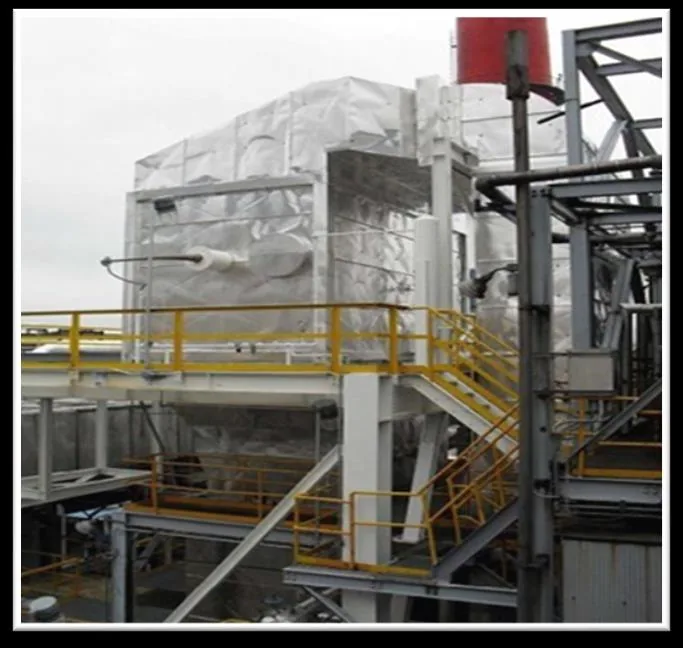
What is in biomass fly ash, and why it sticks
Alkali chemistry is the whole story. Potassium and sodium are nutrients that the plant pulled out of the soil, so they end up concentrated in the residual ash; chlorine travels with them. Typical agro-residue fly ash carries K2O in the high teens to thirties percent, often with chlorine in single digits and sometimes well above it. Wood-derived ash has less alkali but is richer in calcium and silica, depending on how much bark and soil came in with the chip.
Low-melting eutectics set the sticking temperature
Alkali chlorides and sulphates do not need much heat to soften. KCl–K2SO4 mixtures begin to form molten phases at temperatures that a filter vessel sees every day, so ash arriving at the element can be part solid, part liquid film. That is the difference between a dust cake that falls into a hopper and a deposit that has to be chiselled out. It also explains the second symptom operators report: bridging between adjacent elements and across the tube sheet.
Below the dew point it gets worse, not better
Alkali chlorides are strongly hygroscopic. During a shutdown, or while a vessel idles with cold surfaces, condensed moisture and KCl together make a salty paste that hardens when the plant heats back up. Every cement plant and every pulp mill knows the result: a differential pressure that never returns to its previous baseline.
| Fuel family | Typical fly ash character | Consequence for the filter |
|---|---|---|
| Straw and cereal residues | Very high K2O and Cl, low ash fusion temperature | Stickiest duty; demands conservative velocity and disciplined pre-coating |
| Clean wood chip and sawdust | Ca- and Si-rich, moderate alkali, some unburnt carbon | Manageable on ceramic; watch for glowing embers and tar during light-off |
| Refuse-derived fuel and SRF | Variable, chlorine plus heavy metals and plastics-derived salts | Highest variability; needs tight acid gas and dew point control |
| Energy crops and blends | Between straw and wood depending on blend | Design for the worst component of the blend, not the average |
Why fabric media loses this battle
Needled felt filters do not filter at a surface. They filter in depth, and then they rely on the resulting dust cake as the real filtering layer, which is normally a good arrangement. With alkaline biomass fume it is the mechanism of failure.
Sub-micron KCl and K2SO4 fume penetrates between fibre bundles rather than staying on them. Plant operators then see differential pressure rise slowly even at correct air-to-cloth ratios, so they increase pulse frequency, which drives more fine material into the felt; the felt loads, absorbs moisture at the next outage, and the cycle accelerates until the bags are mechanically sound and hydraulically dead. This is the deep blinding failure mode, and no change of pulse strategy rescues it.
There are two further losses. First, glowing particles. Grate-fired biomass boilers carry embers and unburnt char into the hopper zone, and any of them landing on synthetic media leaves a hole; pinhole leaks then load neighbours and the whole compartment goes. Second, the light-off window. Before the bed is properly established, the flue carries tarry condensates that coat everything they touch — the reason commissioning on a biomass boiler is the period that determines the next twelve months of differential pressure.
How a rigid ceramic element changes the failure mode
A ceramic fibre candle is rigid and porous, with filtration taking place at the outer surface only. There is nothing for fine fume to penetrate into, so the deposit has nowhere to go except the outside of the element, where a reverse pulse releases it as flakes or whole sheets. Our non-catalytic ceramic fiber filter runs at >99.99% collection efficiency on sub-micron fume, and it does so with the same number on day one and in year five, because the efficiency belongs to the media rather than to a cake that has to rebuild itself after every pulse.
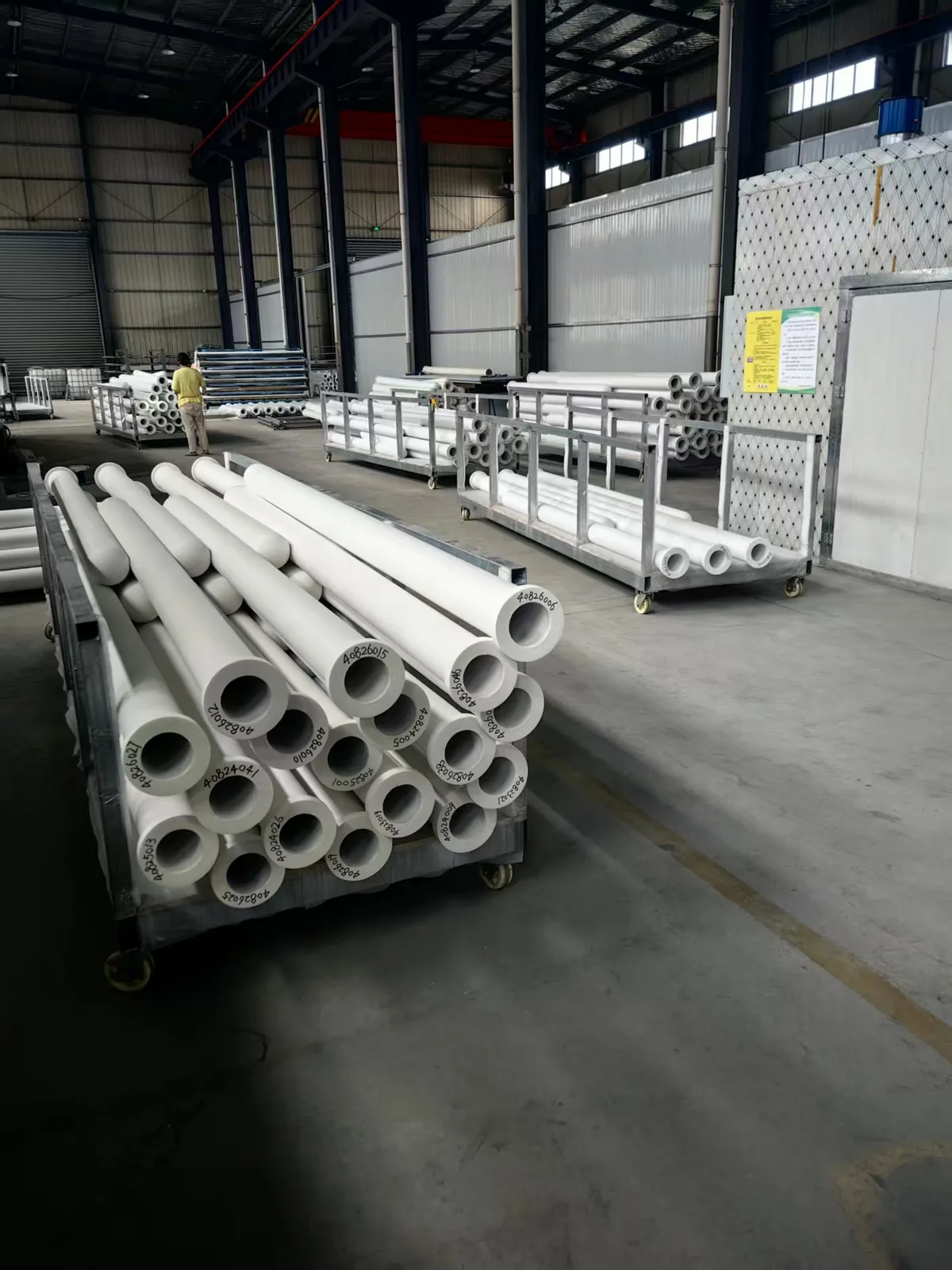
Rigid media also eliminates the two secondary losses: embers cannot burn through a ceramic wall, and the elements tolerate continuous 600°C with short excursions to 1000°C, so a temperature excursion that would destroy a batch of bags is a non-event. Standard supply is φ150 × φ110 × 3,000 mm with a 20 mm wall, porosity >83%, OD ±2 mm and length ±20 mm, delivered for a service life of more than 5 years under a 5-year written warranty. Ceramic installation methods across a range of boilers are covered in more detail among our application references.
Ceramic is not magic: three levers decide the outcome
A sticky deposit can still form on ceramic if the vessel is run carelessly. In our experience every case of poor performance on biomass traces back to one of three things.
- Face velocity. Keep it at or below 1.5 m/min. Higher velocity pushes fume harder against the surface, compacts the cake and makes release less complete. Given the choice on straw ash, take the conservative end of the band and pay for the elements once.
- Stable pulse pressure. Clean at 0.35–0.55 MPa for 0.1–0.15 s, triggered on differential pressure. The number that matters is not the setpoint but its stability: if the header droops below about 0.4 MPa during a sequence, later rows get a weak pulse and accumulate. Use a dedicated receiver close to the vessel, and make sure the air is dry and oil-free — water in pulse air combines with KCl to make exactly the paste you are trying to avoid.
- Pre-coating at every start-up. Before admitting fly ash, lay a protective layer of hydrated lime or ground limestone on the elements so the first sticky fume and any tarry condensate land on a sacrificial powder instead of on clean ceramic. Re-do it after any prolonged outage.
Budget the fan correctly. A clean element measures 350 Pa at 1 m/min face velocity and installed vessels normally run between 900–1,500 Pa. On sticky ash the difference between a good design and a poor one shows up as where in that band you sit after twelve months.
Ask for the ash analysis before you ask for a price
This single habit separates successful ceramic filter projects from difficult ones. If the supplier is quoting you element counts and differential figures without having seen K, Na and Cl numbers, they are quoting from a template. Ask procurement to put the following on the enquiry.
| Data to request from the buyer | What it tells us | Typical design response |
|---|---|---|
| Fly ash K2O, Na2O and Cl content (wt%) | Stickiness, hygroscopicity and eutectic melting behaviour | Lower design velocity, mandatory pre-coat, hopper heating review |
| Ash deformation and softening temperature | Whether the deposit will be molten at the filtration temperature | Move the filtration point or add gas tempering |
| Boiler type and inlet dust loading | Grate and CFB differ by an order of magnitude in dust loading | Add cyclone or multi-cyclone pre-separation on high-loading units |
| Moisture content and minimum operating temperature | Margin above the acid and water dew points | Insulation, heat tracing and a warm-up procedure on clean fuel |
| NOx requirement, if any | Whether catalytic elements are even a candidate | Alkali-rich ash needs a specific catalytic review, not an assumption |
That last row deserves emphasis. Potassium and chlorine are known catalyst poisons, so where a biomass plant has a NOx limit, honest engineering means looking at how much alkali will contact the catalyst before promising a lifetime. The standard product range covers both catalytic and non-catalytic elements precisely so the choice can be made on chemistry rather than on sales convenience.
Commissioning and daily operation on sticky ash
Most of what goes wrong on biomass happens in the first week, and most of it is procedural.
- Warm the vessel on gas or light fuel oil until every surface is above the dew point before introducing biomass, then pre-coat and only then admit fly ash.
- Insulate and, where the climate justifies it, heat trace the hoppers. A cold hopper wall is where sticky ash starts bridging.
- Drain condensate from the compressed air receiver daily during commissioning, and confirm header pressure recovery between rows.
- Keep the bed well stabilised before ramping load; tarry emissions during light-off are the most common cause of early differential pressure complaints.
- Log differential pressure against minutes rather than against calendar date, so an operator can see the cleaning behaviour across a shift instead of guessing.
Frequently asked questions
Will ceramic elements stop sticky biomass ash completely?
They change the failure mode rather than abolishing the problem. Dust cannot embed in a rigid wall, so it releases when pulsed, but if you run above the ash softening temperature or below the dew point you will still build a deposit. Velocity, pulse stability and pre-coating are what make it work.
What face velocity should we design for on straw-fired ash?
Stay at the lower end of our ≤1.5 m/min band, which is. With high-chlorine straw ash we would rather size more elements than spend the campaign fighting differential pressure.
Can we reuse the existing baghouse shell?
Usually yes. The casing, hoppers and pulse piping can generally stay; what changes is the tube sheet, the elements themselves and the hold-down hardware. Check that the fan can deliver 900–1,500 Pa and that hopper slope suits ash that flows less freely than coal ash.
Why does differential pressure rise after every summer outage?
Because hygroscopic KCl picked up moisture while the vessel was cold and baked into a hardened layer. Dry the vessel out fully before the outage, purge it after, and re-apply pre-coat before restarting — the rise is almost always procedural, not a media failure.
Can ceramic withstand embers carried over from the grate?
Yes. The elements run continuously at 600°C with short excursions to 1000°C, so glowing particles that would burn through synthetic fabric simply do not damage them, which removes the pinhole-and-repair cycle that most biomass baghouses live with.
Send us your fly ash analysis with K, Na and Cl figures, plus boiler type and inlet loading, and we will size the vessel for the ash you actually have. Request a biomass filtration quotation.
 English
 Deutsch
 简体中文
 한국어
 日本語
 Español
 Français
 Italiano
 Türkçe
 Tiếng Việt
 Português
 हिन्दी
 العربية
 Polski
 繁體中文